A rigorous introduction to remote viewing as documented in the declassified CIA and DIA Stargate Program, covering the history of the research, the six-stage Coordinate Remote Viewing protocol, the phenomenology of the experience, and the theoretical frameworks for how it might work.
$97
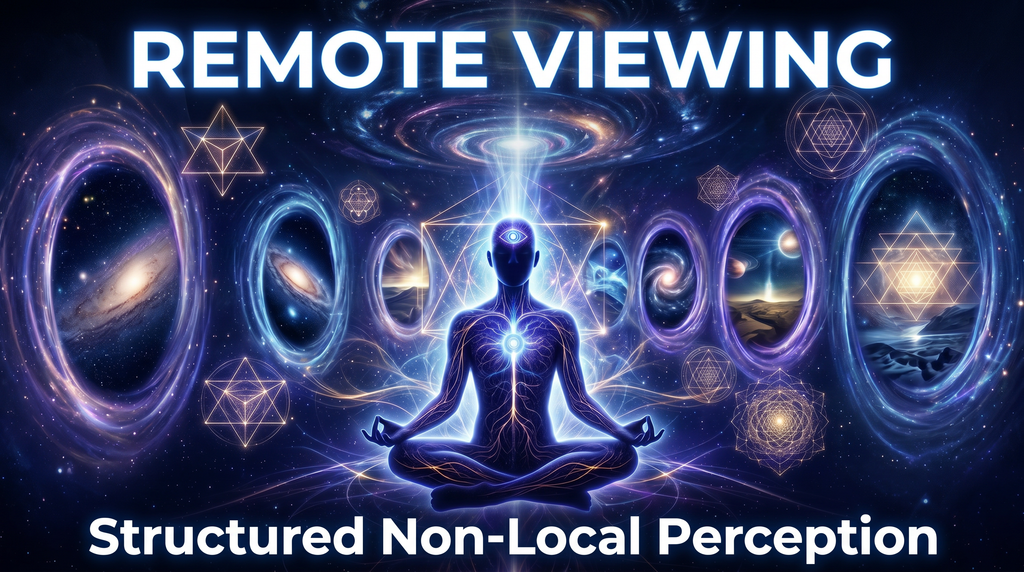
The Question That Brought You Here
You have probably already felt the tension.
On one side sits the mainstream scientific worldview, which tends to treat human perception as strictly local. Bounded by the skull, limited to the senses, confined to the present moment. On the other side sits a sprawling popular market that embraces remote viewing as confirmation of almost anything, uses the word psychic as a selling point rather than a precise technical term, and rarely bothers to distinguish between serious documented evidence and wishful thinking.
And somewhere between those two unsatisfying positions, you have been sitting with a question that neither side seems willing to engage honestly:
“Did the United States government really fund twenty-three years of research into whether trained individuals could perceive remote locations, and if so, what did they find?”
That is not a rhetorical question. It is the central question of this course. And the answer to the first part is straightforward: yes. The Stargate Program is not a rumor or a conspiracy theory. It is a documented chapter of American intelligence history, and the records are now public.
What those records show, what they do not show, how the mechanism might work, and what any of it means for your understanding of consciousness and perception. That is what this course takes seriously. You will not be told what to believe. You will be given the tools to investigate for yourself.
What This Course Is and What It Is Not
This Course Is
1. A rigorous examination of the Stargate Program’s documented history, grounded in the declassified CIA archive and peer-reviewed assessments by credentialed researchers.
2. A complete working map of the six-stage CRV protocol, substantially expanded with the reasoning behind each stage and the phenomenology of what genuine practice feels like from the inside.
3. An honest engagement with four serious theoretical frameworks for how non-local perception might work, held without collapsing prematurely into either dismissal or certainty.
4. A practical guide to building a sustained personal practice: where to get blind targets, how to evaluate sessions honestly, how to keep records that teach you something over time.
What This Course Is Not
1. A promotion of remote viewing as a proven, reliable, on-demand capability. The evidence is real. The limitations are equally real. Both are stated plainly.
2. A simplified meditation technique dressed up with military vocabulary. The protocol exists because it was built empirically to solve a specific problem, analytical overlay, and every stage reflects that.
3. A course that will tell you what to believe. You will examine the evidence. You will work the protocol. You will reach your own conclusions.
4. An entry point and exit point. The course is designed to be the beginning of practice, not a substitute for one.
Who This Course Is For
This course was designed to serve two populations simultaneously: serious skeptics who want to engage the evidence without being asked to abandon their critical faculties, and genuine seekers who want a rigorous foundation rather than another layer of speculation layered on top of belief they already hold. Both will be challenged. Both will find what they need here.
You will likely recognize yourself here:
The Serious Skeptic
You’ve encountered remote viewing before and written it off. Reasonably, given most of what circulates about it. But something about the institutional context keeps nagging at you. Twenty-three years. Multiple administrations. A statistical assessment by a credentialed University of California statistician who said the effect was real. You want to look at the actual evidence, not the mythology that surrounds it.
The Consciousness Researcher or Practitioner
You’ve been working with meditation, inner development, or non-ordinary states of awareness for some time. You’ve had experiences that your current frameworks don’t fully account for. You want a rigorous, documented entry point into the question of non-local perception. One that doesn’t require you to leave your intelligence at the door.
The Scientifically Literate Inquirer
You have a science background or a scientist’s habits of mind, and you’re interested in anomalous phenomena precisely because they’re anomalous. If the effect is real, you want to understand the evidence base that establishes it. If the mechanism is unknown, you want to engage seriously with the theoretical frameworks that attempt to account for it. You can handle uncertainty. What you can’t handle is handwaving.
The Student of The Great Work Platform
You’ve encountered the broader curriculum. The Hermetic principles, the consciousness work, the intersection of ancient wisdom and modern science. Remote viewing is one of the most direct empirical demonstrations available that consciousness operates beyond the boundaries our dominant models assign to it. That fact is worth examining with the same rigor you’ve brought to everything else.
The Genuinely Curious
You heard about the CIA’s psychic spies and you want to know what happened. That is a completely legitimate reason to be here. The documented history alone, independent of anything you decide to believe about the mechanism, is one of the stranger and more genuinely interesting chapters in modern institutional history. You are going to find this worth your time.
Prerequisites: No background in physics, parapsychology, or meditation is required. The course teaches everything you need. What is required: intellectual honesty, the willingness to hold uncertainty without rushing to resolve it, and enough patience to work a protocol carefully before deciding what to make of it.
Meet James Sageman
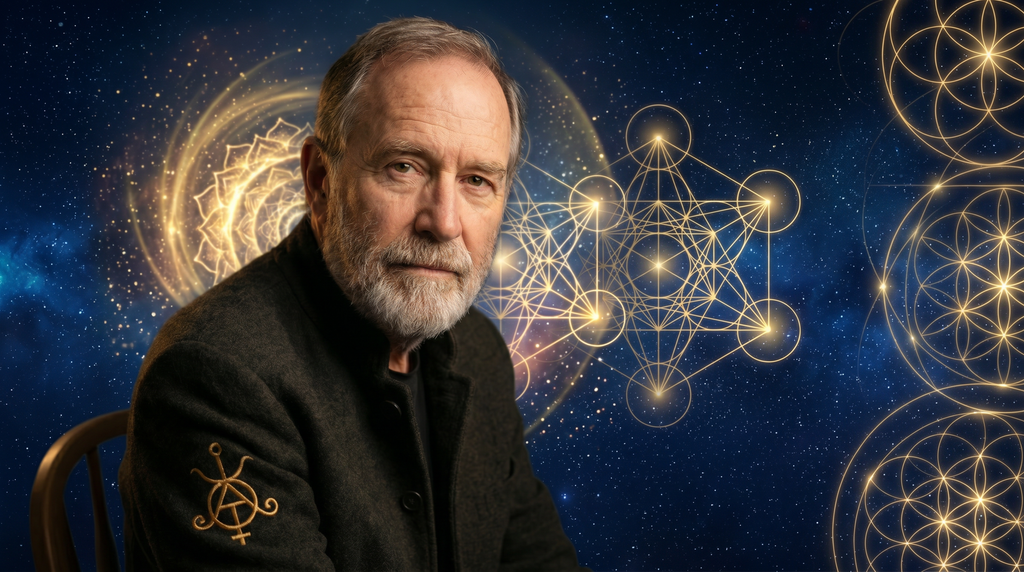
James Sageman has been sitting with questions about the nature of consciousness and perception for a long time.
He grew up in rural Vermont, where honesty and independent thinking were not aspirational values but simply how people lived. He spent six years in the United States Navy aboard the USS Kitty Hawk, deploying to the Persian Gulf, before building a forty-year career in engineering and technical roles in and around Colorado Springs.
Along the way, he pursued a quieter and more consuming inquiry: deep study and practice in alchemy, the Hermetic principles, meditation, shadow work, and the intersection of ancient wisdom traditions with modern science. Through decades of dedicated work, he arrived at what many traditions call self-realization. Not as a credential. As a living fact that shapes everything he teaches.
His interest in remote viewing is not separate from that path. It is one of its branches. The same quality of attention genuine remote viewing trains. The capacity to be present with what is arriving before interpretation rushes in to tell you what it means, is foundational to every serious inner practice James has studied and taught. These are not parallel tracks. They are the same track.
He is the creator of The Great Work Platform, the author of The Great Work: A Guide to Personal and Collective Awakening, and the designer of courses on consciousness, Hermetic philosophy, and quantum metaphysics. He teaches the way he writes: plainly, honestly, and from the inside of the practice. Not from above it.
“Consciousness is the foundation. Change consciousness, and you change everything.”
James Sageman
The Five-Module Curriculum
The course is organized into five modules that build deliberately on each other. You begin with the documented history. Not theory, not belief, but what the primary record shows. You move through the complete CRV protocol, the phenomenology of practice, the theoretical landscape, and finally into the structure of sustained personal practice. Each module prepares you for the next. The arc is complete.
Module 1: The Documented History: What the Declassified Record Shows
Twenty-three years of government-funded research. Serious scientists at serious institutions. Operational intelligence gathered from trained viewers. This module examines the primary record honestly. What the Stargate Program established, what it failed to establish, and what the gap between its statistical findings and its termination reveals about how evidence gets evaluated in institutional contexts.
Module 2: The Six Stages of Coordinate Remote Viewing
Ingo Swann developed the CRV protocol empirically. Not from theory, but from observation of what made sessions work better and what made them worse. This module gives you a complete working map of all six stages: what each one is designed to do, why the sequence is built the way it is, what it feels like from the inside, and what tends to go wrong. The protocol isn’t a set of arbitrary rules. Every step is load bearing.
Module 3: The Phenomenology of Remote Viewing
Understanding the CRV protocol intellectually and knowing what a session feels like from the inside are two genuinely different things. This module draws on the phenomenological accounts of experienced Stargate viewers, particularly Joseph McMoneagle’s published record, to build your ability to feel the difference between genuine signal and analytical overlay in real time. The most valuable skill a remote viewer develops is discrimination, and discrimination cannot be memorized. It must be developed through honest practice and careful attention.
Module 4: Theoretical Frameworks: How Non-Local Perception Might Work
The phenomenon has been documented. The mechanism remains genuinely unknown. This module examines four serious theoretical frameworks; quantum non-locality and entanglement, morphic field theory, holographic brain models, and consciousness-first cosmologies, and treats each as a real attempt to grapple with a real puzzle. Which framework best accounts for your direct experience of practice? What would it take to falsify the one you find most plausible? These are the questions this module leaves you holding.
Module 5 Building a Personal Remote Viewing Practice
The course does not end here. The practice does. Where to obtain reliable blind targets. How to evaluate sessions with the granular honesty that produces learning. How to keep records that teach you something about your own perception over time. And how to stay with the work through the dry periods, the sessions that produce nothing, the weeks when nothing seems to be arriving, with enough patience and discipline to let genuine skill develop. The distance between knowing the protocol and having worked it long enough for discrimination to become instinctive is measured in sessions conducted honestly over time.
What You Will Be Able to Do
These are concrete, verifiable skills and capacities. Not vague transformational promises.
- Describe the documented history of the Stargate Program accurately, drawing on the declassified CIA archive, the SRI research record, and the assessments by Jessica Utts and Ray Hyman.
- Explain the six stages of the Coordinate Remote Viewing protocol and the reasoning behind each stage’s design. ot just what each stage is, but what problem it was built to solve.
- Distinguish between genuine signal and analytical overlay in your own sessions, developing the discrimination that experienced viewers identify as the central skill of the practice.
- Evaluate the four major theoretical frameworks for non-local perception; quantum non-locality, morphic field theory, holographic brain models, and consciousness-first cosmologies, with enough precision to identify what each would predict and what would falsify it.
- Conduct structured remote viewing sessions using a blind target protocol, document your results with the granularity required for honest self-evaluation, and assess your sessions against verifiable feedback.
- Build and sustain a personal practice: sourcing reliable blind targets, keeping records that accumulate into a genuine learning history, and maintaining the quality of attention through the uneven development that characterizes any serious practice.
- Situate remote viewing within the broader questions of consciousness, perception, and the nature of mind. Connecting what you have learned here to the wider curriculum of The Great Work Platform.
Frequently Asked Questions
Do I need any background in parapsychology or physics?
No. The course explains every concept it uses, including the relevant physics and the statistical methods used to evaluate the Stargate evidence. What you need is the willingness to engage the material honestly and the patience to work the protocol carefully. Neither of those require any prior background.
I’m a hard skeptic. Will I be asked to believe things I find implausible?
No. Rigorous skepticism is one of the most welcome positions in this course. The entire premise is that the evidence deserves honest examination, and honest examination includes the possibility that the most parsimonious explanation for the data is something other than non-local perception. You will not be pressed toward any conclusion. You will be given access to the primary record and the tools to evaluate it for yourself.
What if I try the practice and nothing seems to work?
That is a real possibility and an honest one to hold. Remote viewing is not a skill that manifests reliably on command, and early sessions rarely produce dramatic results. What the practice asks of you is sustained, honest engagement over time. Working the protocol carefully, evaluating your sessions against verified feedback, and staying with the work through the inevitable dry periods. Whether anything develops depends on factors that no course can guarantee. What this course can guarantee is a rigorous foundation and an honest framework for evaluating what you experience.
How much time does this course require each week?
Plan on four to six hours per week across the five modules. Reading, guided practice sessions, session documentation, and analytical exercises. The practice sessions build on each other and are designed to accumulate into a complete body of work by the final module. Students who engage fully, and who are honest in their session evaluations, tend to get the most out of the course.
What do I receive when I enroll?
Lifetime access to all five expanded module guides, including the complete CRV protocol documentation, phenomenology frameworks, theoretical analysis tools, and practice session structure. Access to blind target resources. Session documentation templates. Community forum access. And the bridge passages connecting each module to the next, which are designed to make the arc of the course genuinely coherent rather than just a collection of topics.
Your Inner Work Is the Most Powerful Thing You Can Do for the World
If you have read this far, something in you already knows.
You know that the question sitting at the intersection of documented evidence and genuine mystery is not a small one. Whether trained human beings really accessed remote locations under controlled conditions. Whether twenty-three years of government-funded research into this possibility produced results that a credentialed statistician called real. And whether those results were terminated anyway because they didn’t fit the model rather than because the evidence failed. Whether the quality of attention that remote viewing trains are, at its deepest level, the same quality of attention that every serious contemplative tradition has been asking us to develop.
These are consequential questions. And most of the treatment available in this territory has been either too dismissive or too credulous. Too willing to reach a comfortable conclusion before the inquiry has been properly conducted. This course does not do that. It holds the question honestly, for five modules, with the tools to navigate it rigorously.
“The first step in any genuine inquiry is agreeing to not know the answer before we begin. That sounds obvious. It turns out to be harder than it sounds.” -James Sageman
The documented history is real. The protocol is real. The phenomenology is real. The questions the theoretical frameworks raise are genuinely unresolved. What you make of all of that, what you come to believe, or to hold with productive uncertainty, or to practice, is your work to do.
Five modules. Decades of documented research and authentic practice distilled into a single, honest architecture of inquiry you can carry forward for the rest of your life.
The Great Work is here. The Great Work is now. And the Great Work is you.
James Sageman
$97