Learn how consciousness actually participates in the creation of reality, grounded in philosophy, empirical science, contemplative tradition, and honest personal practice.
Taught by James Sageman. Fifteen modules. No dogma, no hype, no hedging.
Welcome home.
$197
The Question That Brought You Here
You already know something is off.
Maybe you have tried the visualization apps and the vision boards. Maybe you have read the books. Maybe you have had moments where something actually shifted, and other moments where nothing happened at all. You cannot quite explain the pattern.
Or maybe you are the skeptic in the room. You watched someone close to you fall into the “good vibes only” world and you saw what it cost them. You have good reasons to doubt, and you are also honest enough to admit that the placebo effect is real, that expectation changes outcomes in ways that are measurable, and that there is something to this question that mainstream science has never quite been willing to sit with.
Either way, you are asking the same question.
Does consciousness actually participate in the creation of reality? And if it does, how? Through what mechanisms? With what limits? What can you reasonably hope to change, and what is beyond the reach of any inner practice?
This is the central question of quantum mechanics, modern neuroscience, philosophy of mind, medicine, and every serious contemplative tradition in human history. And almost nobody is teaching it with the care it deserves.
That is what this course is for.
Why Most Manifestation Teaching Fails
Most manifestation teaching fails for a simple reason. It oversimplifies.
It picks one mechanism, usually the most speculative and exciting one, and pretends that is the whole story. “The universe is conspiring in your favor.” “Just raise your vibration.” “Like attracts like.” The result is a practice that ignores the bulk of what is actually producing the results it claims, leaves people blaming themselves when it does not work, and hands ammunition to every critic who dismisses the entire field.
Consciousness does participate in reality. The evidence is real. But the mechanisms are multiple, the science is specific, the philosophy is older and deeper than Instagram suggests, and the shadow side of this work (the victim blaming, the spiritual bypassing, the magical thinking) has to be named honestly if the practice is ever going to mature.
Reality Architecture takes the whole picture seriously.
Pillar What it means for your practice
Rigor Every claim is examined through four lenses: empirical evidence, philosophical reasoning, contemplative tradition, and pragmatic testing in your own life.
Honesty No cherry-picked success stories. Where the evidence is strong, we say so. Where it is weak, we say that too. Where the tradition has caused harm, we look at it directly.
Integration Seven mechanisms of conscious reality-engagement, ranked by evidential strength, woven into a single practice that works with all of them at once.
What This Course Is, and What It Isn’t
WHAT THIS COURSE IS
- A rigorous investigation into the relationship between consciousness and physical reality, drawing on philosophy of mind, neuroscience, quantum mechanics, psi research, and the major contemplative traditions.
- A practical, seven-mechanism framework you can test in your own life, with designed self-experiments and honest tracking of results.
- A deep engagement with Neville Goddard, Hermetic philosophy, predictive processing neuroscience, and the history of Western and Eastern thought on consciousness.
- An ethical treatment of the shadow side of manifestation teaching: victim blaming, spiritual bypassing, privilege blindness, and magical thinking.
- A guided process for building your own Reality Architecture, a personal, evidence-informed framework you will carry forward for life.
WHAT THIS COURSE IS NOT
- A law-of-attraction seminar. Those products have a place in the market. This is not one.
- A promise that you will manifest a Porsche, a soulmate, or a seven-figure business in ninety days.
- A spiritual-but-not-religious identity package. The content is substantive regardless of your starting worldview.
- A course that will confirm everything you already believe. You will be asked to examine the places where your own thinking is weakest. So will everyone else.
- A substitute for medical care, therapy, or engagement with the real structural conditions of your life. The practice works best when it is held alongside those things, not in place of them.
Who This Course Is For
This course is built for intelligent adults who are done being talked down to. By the scientific establishment, which has too often dismissed the entire question. And by the spiritual marketplace, which has too often turned it into a sales funnel.
You will likely recognize yourself here:
Disillusioned manifestation students.
You have tried Law of Attraction approaches, had mixed or no results, and want to understand why. You suspect there is a more rigorous, more effective approach. There is.
Philosophically minded seekers.
You are drawn to the question of consciousness and reality but you are repelled by the superficiality of most manifestation content. You want depth without dogma.
Scientists and skeptics.
You recognize that placebo effects, observer effects, and expectation effects are real. You want to understand their limits and mechanisms without being asked to believe anything you cannot evaluate.
Contemplative practitioners.
You have sat on the cushion long enough to know that inner states shape outer experience. You want a framework that honors what you already know while extending it.
Neville Goddard students.
You are drawn to Goddard’s sophisticated approach and you want to understand the science and philosophy that supports (and in places challenges) his teaching.
Therapists, coaches, and educators.
You work with other people’s belief systems and self-concept. You want a deeper, more ethically grounded framework to draw on.
Creative professionals.
Artists, entrepreneurs, innovators. You experience the creative process as genuinely reality-shaping. You want to understand it more deeply.
Prerequisites:
None. Just intellectual curiosity, a tolerance for ambiguity, and a willingness to have both your scientific and your spiritual assumptions challenged.
Meet Your Instructor
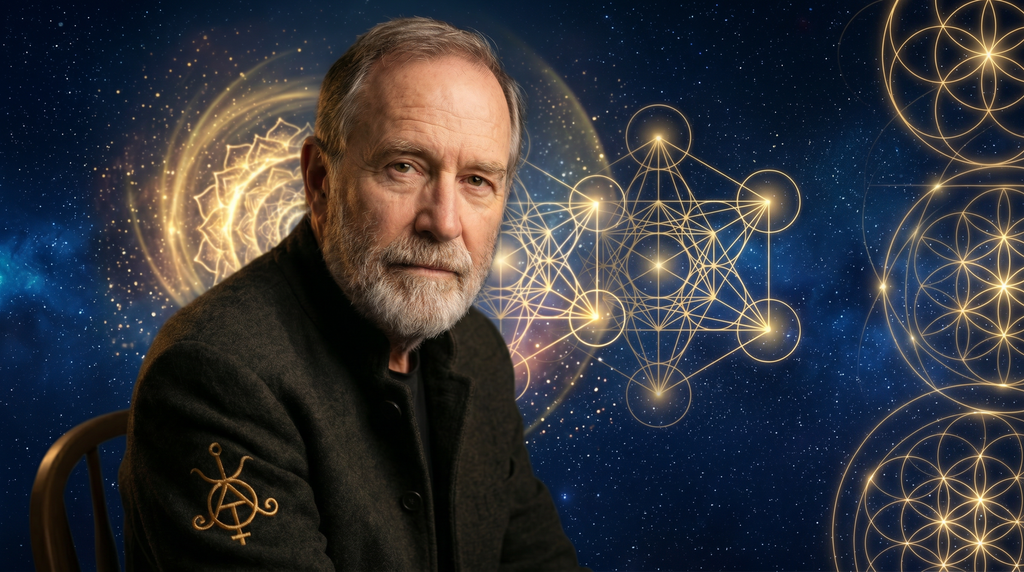
James Sageman has spent more than forty years living with the questions this course addresses.
James grew up in the rural north of Vermont, where independence and loyalty were not aspirational values but the simple baseline of how people lived. He served six years in the United States Navy aboard the aircraft carrier USS Kitty Hawk, deploying to the Persian Gulf and a dozen countries beyond. He built a forty-year career in engineering and technical roles in Colorado Springs. Along the way, he pursued a quieter path: decades of study and practice in alchemy, the Hermetic tradition, meditation, shadow work, and the intersection of ancient wisdom with modern science.
James is the creator of The Great Work Platform, author of “The Great Work: A Guide to Personal and Collective Awakening,” and the designer of courses on consciousness, Hermetic philosophy, and quantum metaphysics.
James teaches the way he writes. Plainly. Honestly. From the inside of the practice, not from above it.
Consciousness is the foundation. Change consciousness, and you change everything.
James Sageman
Brief Summaries for 15 Module Curriculum
The course is organized into five parts across fifteen modules. Each module builds on the last. Together they form a complete architecture, from the history and philosophy of the question, through the empirical science, through the contemplative traditions, through the ethics, and finally into the practice you will carry forward for the rest of your life.
PART I: Foundations
Module 0 — Orientation: The Most Important Question You’ve Never Taken Seriously.
Why this is the central question of quantum mechanics, neuroscience, philosophy of mind, medicine, and every wisdom tradition. Why the New Age trivialized it and mainstream science dismissed it. What changes if the answer is yes, and what changes if the answer is no.
Module 1 — The Long History of the Idea.
From the Corpus Hermeticum through the Upanishads, the Christian mystics, the Kabbalists, Quimby, Troward, and the American New Thought movement. The oldest thread in human thought, traced with philosophical care.
PART II: The Science
Module 2 — The Placebo Effect and Psychoneuroimmunology: The Body Believes.
The most well-documented case of belief influencing physical reality. How far does it extend? The precise pathways by which belief affects the body, and the honest limits of those pathways.
Module 3 — The Neuroscience of Belief: How the Brain Constructs Reality.
Predictive processing, the Bayesian brain, neuroplasticity, and self-fulfilling prophecy. The most robust and well-replicated science in this course. Why it may be enough to explain everything, and why it may not.
Module 4 — The Psi Research: Evidence, Limits, and Honest Skepticism.
The PEAR Lab. The Global Consciousness Project. Dean Radin’s meta-analyses. The Ganzfeld experiments. Where the evidence is surprisingly strong, where it is genuinely weak, and how to tell the difference.
Module 5 — Quantum Mechanics and Consciousness: What the Physics Actually Says.
The measurement problem. The interpretations. QBism, Bohmian mechanics, Everett’s many worlds, and participatory realism. What working physicists actually believe, and how to spot bad quantum metaphysics in the wild.
PART III: The Philosophy
Module 6 — Neville Goddard and the Architecture of Imagination.
The most philosophically sophisticated manifestation teacher of the twentieth century. Feeling as the secret. The State Akin to Sleep. Revision. The 4D self. Evaluated with care, on its own terms, and through the four-lens framework of this course.
Module 7 — The Wisdom Traditions Converge.
Hermetic, Vedantic, Buddhist, Kabbalistic, and Christian-mystical views on consciousness and reality. Where they agree, where they diverge, and what their agreement can reasonably be taken to mean.
Module 8 — Modern Philosophy of Mind.
Idealism, panpsychism, dual-aspect monism, and participatory realism. The frameworks that make room for consciousness as something more than a latecomer in a dead universe. How to build your own working model.
PART IV: The Practice
Module 9 — The Shadow of Manifestation: What Nobody Wants to Talk About.
Victim blaming. Spiritual bypassing. Privilege blindness. Magical thinking. The seven shadows that distort this teaching and the ethical framework that keeps the practice honest.
Module 10 — The Multi-Mechanism Model: How Manifestation Actually Works.
The synthesis module. Seven mechanisms of conscious reality-engagement, ranked by evidential strength. The Reality Architecture Practice (RAP), a seven-phase daily discipline that engages every mechanism in sequence.
Module 11 — Advanced Practices: Identity Shifts, State Management, and Deep Imagination.
What separates practitioners who get consistent results from those who drift. Identity-level change. Heart coherence. SATS with the scene-looping method. Revision. The techniques, and the neuroscience that explains why they work.
Module 12 — Experimental Design: Testing Your Own Reality.
How to design self-experiments that actually yield trustworthy information. Pre-registration. Alternative explanations. The cognitive biases that will try to hijack your conclusions, and how to account for them.
PART V: Integration
Module 13 — The Paradox of Intention and Surrender.
The deepest teaching in every wisdom tradition: the place where clear intention and complete surrender are the same gesture. Wu wei. The flow state science. Learning to want from wholeness, not from lack.
Module 14 — Honest Reckoning: What Actually Happened.
Grand compilation of your experiments and practices across the course. What worked, what did not, and what you honestly believe now that the evidence is in.
Module 15 — Capstone: Your Reality Architecture.
Synthesize everything studied, practiced, and honestly evaluated into a living framework for conscious reality-engagement you will carry forward beyond this course. The final deliverable. Not a summary. A statement of where you now stand.
What You Will Be Able to Do
By the time you complete this course, you will be able to:
- Articulate at least five philosophical frameworks for understanding the relationship between consciousness and reality, and evaluate each on its merits.
- Critically assess empirical evidence for consciousness influencing physical reality, distinguishing established findings from speculative extrapolation.
- Analyze manifestation teachings (including Neville Goddard’s) with philosophical precision, identifying their assumptions and their relationship to the evidence.
- Explain the neuroscience of belief and expectation at a level sufficient to teach it to someone else.
- Design and execute your own experiments in conscious reality-engagement with honest tracking of results and alternative explanations.
- Execute a complete seven-phase daily practice (the Reality Architecture Practice) that engages every established mechanism of mind-to-reality influence.
- Navigate the ethical dimensions of this work without sliding into victim blaming, spiritual bypassing, or magical thinking.
- Speak and write about manifestation and consciousness with precision and integrity, avoiding both dismissive skepticism and uncritical credulity.
- Carry a complete, personal, evidence-informed Reality Architecture into the rest of your life.
Frequently Asked Questions
How much time will this course take?
Plan on six to eight hours per week. Readings, lecture videos, journaling, and the practices built into each module. Students who do less will still benefit, though the course is designed to reward genuine engagement. Students who do significantly more tend to report the most substantial shifts.
Do I need a background in philosophy, science, or meditation?
No. The course assumes intelligent curiosity, not prior specialization. Every concept that requires explanation is explained. The reading list is comprehensive but not required reading. You will get out of this course exactly what you put in.
I am a hard skeptic. Will I feel out of place?
You will feel at home. The course takes skepticism seriously as one of the four lenses of inquiry. A rigorously argued conclusion that consciousness has no non-physical effect on reality is as valid an outcome here as a deep synthesis of ancient wisdom and lived experiment. The course’s commitment is to honest inquiry, not to any particular conclusion.
I have been hurt by manifestation culture. Can I trust this course?
Module 9 is devoted entirely to the shadow side of manifestation teaching, including the harm it has caused to the sick, the poor, and the traumatized. The instructor does not pretend to be above those failures. He has watched them up close, named them clearly, and built the course in such a way that the same mistakes cannot quietly be repeated.
What do I get when I enroll?
Lifetime access to all fifteen module lessons, including lecture videos, expanded course guides, reading lists, worksheets, guided practice audio, and the complete Reality Architecture Practice protocol. Self-experiment templates. Community forum access.
Ready to Dive In?
If you have read this far, something in you already knows.
You know that the question of consciousness and reality is not settled, and that the confident voices on both sides have more certainty than the evidence warrants. You know that the practices you have been offered so far have not quite matched the depth of what you were looking for. You know that you are ready for something more serious.
Reality Architecture is that course.
Fifteen modules. Forty years of study and practice condensed into a single living architecture you can build inside yourself. No dogma. No hype. No hedging.
Your inner work is the most powerful thing you can do for the world. And the inner work of this course, learning to think clearly, practice honestly, and live consciously, is among the most important inner work available to a human being in the twenty-first century.
The Great Work is here. The Great Work is now. And the Great Work is you.
Welcome home.
$197