A scholarly and phenomenologically rigorous examination of what psychedelic and entheogenic experiences reveal about the nature of consciousness. The course covers the modern psychedelic renaissance, the cross-cultural history of entheogenic traditions, filter theory, cartographic analysis of psychedelic states, and the critical importance of integration.
$97
The Question That Brought You Here
You have probably already felt the sorting reflex.
Say the word psychedelics in most rooms, and people separate into camps before you finish the sentence. One camp hears drugs and stops listening. The other hears medicine, or sacrament, and starts nodding before any evidence has been presented. Both reactions are understandable. Neither one is looking at what is in front of us.
What is in front of us is substantial. Randomized controlled trials at Johns Hopkins and Imperial College London showing large, durable reductions in depression and existential distress. A twenty-three-year federal research freeze now colliding with more than a hundred published clinical trials. An anthropological record, from the barley fields of ancient Eleusis to the mushroom stones of Preclassic Guatemala, showing that human beings have been doing this, deliberately and ceremonially, for thousands of years. And underneath all of it, one of the oldest questions in philosophy: does the brain generate consciousness, or does it filter and constrain a consciousness that was never simply its own?
“Does the brain make consciousness, or does it filter something it never fully contained?”
That is not a rhetorical question. It is the central question this course holds. And I am not going to pretend it is settled, because it is not. I am also not going to pretend the evidence is thin, because it is not that either.
What this course offers is the same thing I try to offer in everything I write: a clear look at real evidence, held without needing to have decided in advance what it proves.
Why This Course Is Different
Most treatments of this subject do one of two things. They dismiss the whole territory as recreational drug culture with a lab coat on, or they promote it so enthusiastically that the actual clinical and historical record gets buried under sales copy. This course does neither.
What makes this inquiry different is where it looks. Not at what people say about the Johns Hopkins and Imperial College trials, but at the trials themselves: the sample sizes, the response rates, the honest setbacks alongside the genuine breakthroughs. Not at a flattened, borrowed version of Eleusis or the Amazonian ayahuasca traditions, but at the archaeological evidence, the primary historical sources, and the scholars who have spent careers studying them.
And one boundary is worth stating plainly, because it shapes everything that follows: this is a scholarly course, not a how-to guide. Every exercise in these six modules is a reading, writing, or reflective exercise. Several of the substances discussed are controlled or illegal in most jurisdictions, and several carry real physiological and psychological risk even where they are legal. Nothing here is medical, legal, or clinical advice, and nothing here instructs, encourages, or facilitates substance use of any kind. What this course offers is something prior to that question entirely: an honest look at what these experiences have revealed, across laboratories, cultures, and centuries, about the nature of consciousness itself.
What This Course Is and What This Course Is Not
| This Course Is |
| A scholarly examination of the clinical, historical, and philosophical record surrounding psychedelic and entheogenic experience, grounded in peer-reviewed research and primary sources. |
| A complete survey of the major frameworks used to understand these states: filter theory, cartographic models, the science of integration, and the DMT entity phenomenon. |
| An honest engagement with genuinely unresolved questions, including whether the brain produces consciousness or merely filters it. |
| A practical framework for understanding what actually determines whether a profound experience, of any kind, changes a person’s life. |
| This Course Is Not |
| A promotion of psychedelic or entheogenic substance use as safe, proven, or recommended. Several of the substances discussed are controlled or illegal in most jurisdictions and carry real risk. |
| A how-to guide of any kind. Every exercise is a reading, writing, or reflective exercise. Nothing in this course instructs, encourages, or facilitates substance use. |
| A course that tells you what to believe. You will examine the evidence and the live philosophical dispute for yourself. |
| Medical, legal, or clinical advice of any kind. Whether to pursue any experience described in this course is a separate question this course is not built to answer. |
Who This Course Is For
This course was designed to serve readers who want a rigorous foundation rather than another layer of speculation stacked on top of belief they already hold. It will challenge easy dismissal and easy enthusiasm in equal measure.
You will likely recognize yourself here:
The Serious Skeptic
You hear the word psychedelics and assume recreational drug culture dressed up in academic language. Reasonably, given most of what circulates about it. But numbers like a seventy-eight percent clinical response rate at Johns Hopkins keep nagging at you. You want to look at the actual evidence, not the mythology that surrounds it.
The Consciousness Researcher or Practitioner
You have been working with meditation, inner development, or non-ordinary states of awareness for some time. You want a rigorous, documented entry point into the question of what these states reveal about the mind, one that does not require you to leave your intelligence at the door.
The Scientifically Literate Inquirer
You have a science background or a scientist’s habits of mind. You can handle real uncertainty, including open empirical questions like whether endogenous DMT ever reaches meaningful concentrations in the human brain. What you cannot handle is handwaving.
The Student of The Great Work Platform
You have encountered the broader curriculum: the Hermetic principles, the consciousness work, the intersection of ancient wisdom and modern science. The clinical psychedelic renaissance is one of the more direct places where modern research is, whether it fully realizes it or not, catching up to what contemplative traditions have taught for millennia. That is worth examining with the same rigor you have brought to everything else.
The Genuinely Curious
You have seen the headlines about mushrooms and depression and you want to know what the research actually found, not the clickbait version of it. That is a completely legitimate reason to be here, and you are going to find this worth your time.
Prerequisites: No background in pharmacology, neuroscience, or philosophy is required. This course is educational content only; no substance use is involved, encouraged, or instructed anywhere in it. What is required is intellectual honesty, the willingness to hold real uncertainty without rushing to resolve it, and enough patience to read primary evidence carefully before deciding what it means.
Meet James Sageman
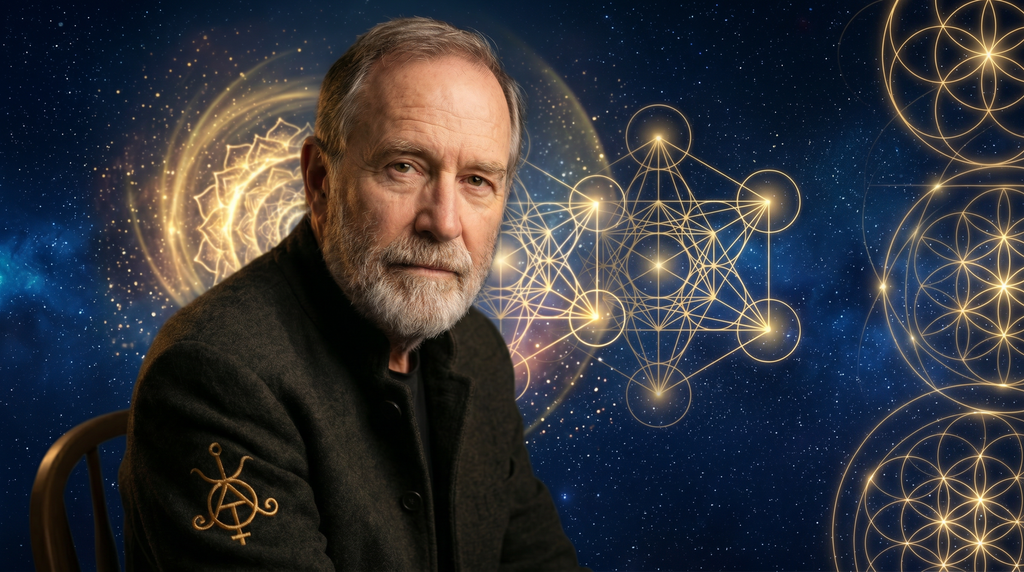
James Sageman has been sitting with questions about the nature of consciousness for a long time.
He grew up in rural Vermont, where honesty and independent thinking were not aspirational values but simply how people lived. He spent six years in the United States Navy aboard the USS Kitty Hawk, deploying to the Persian Gulf, before building a forty-year career in engineering and technical roles in and around Colorado Springs.
Along the way, he pursued a quieter and more consuming inquiry: decades of dedicated study and practice in alchemy, the Hermetic principles, meditation, and shadow work. Through that work, he arrived at what many traditions call self-realization, not as a credential, but as a living fact that shapes everything he teaches.
His interest in the clinical and historical record of psychedelic and entheogenic experience grows directly out of that path. The Hermetic tradition has always taught that consciousness is primary, that the physical world is an expression of mind rather than the reverse. Watching modern neuroscience and clinical psychiatry circle back, on their own evidence, toward a version of that same question is not a side interest for James. It is the same inquiry, approached from a different door.
He is the creator of The Great Work Platform, the author of The Great Work: A Guide to Personal and Collective Awakening, and the designer of courses on consciousness, Hermetic philosophy, and quantum metaphysics. He teaches the way he writes: plainly, honestly, and from the inside of the work. Not from above it.
“Consciousness is the foundation. Change consciousness, and you change everything.”
– James Sageman
The Six-Module Curriculum
The course is organized into six modules that build deliberately on each other. You begin with the modern clinical record, then travel back through thousands of years of cross-cultural ceremonial use, then sit with the philosophical question of what these states actually imply about the brain and mind, then survey the major maps drawn of that territory, then confront the work of integration that determines whether any of it matters, and finally meet the strangest and most unresolved phenomenon in the field. Each module prepares you for the next. The arc is complete.
| Module 1 | The Psychedelic Renaissance: What the Clinical Record Actually Shows From the roughly forty thousand patients studied in published clinical papers between 1950 and 1965, through the Controlled Substances Act’s near-total research freeze, to the modern Johns Hopkins and Imperial College trials and the real regulatory setback of the MDMA-for-PTSD program. You learn to read a clinical study like a scientist, not a believer. |
| Module 2 | Entheogenic Traditions Across Cultures Four geographically isolated cultures; Greek, Vedic, Mesoamerican, and Amazonian, each independently built structured ceremonial practice around consciousness-altering plants and fungi. Eleusis, the Vedic soma cult, Mesoamerican teonanácatl practice, ayahuasca and the Santo Daime church, and peyote and the Native American Church. |
| Module 3 | Filter Theory, the Reducing Valve, and What Psychedelics Reveal Does the brain make consciousness, or does it filter and constrain something larger? From Henri Bergson’s 1896 wager through William James’s prism and Aldous Huxley’s reducing valve, into the live dispute between philosophers Bernardo Kastrup and Chris Letheby playing out in today’s neuroimaging data. |
| Module 4 | Cartographic Analysis: Mapping the Psychedelic Territories Four serious attempts to map non-ordinary consciousness: Stanislav Grof’s four domains, drawn from roughly three thousand guided LSD sessions; the Tibetan Book of the Dead as repurposed by Leary, Metzner, and Alpert; Robin Carhart-Harris’s Ego-Dissolution Inventory; and Walter Pahnke’s nine-category mysticism scale. |
| Module 5 | Integration: The Variable That Determines Everything Every major research program and every contemplative tradition converges on the same unglamorous conclusion: the peak experience is not the achievement. What you do with it afterward is. You learn John Welwood’s distinction between realization and integration, and design a five-phase integration protocol of your own. |
| Bonus Section | The DMT Phenomenon: Encounter at the Edge of the Model Rick Strassman’s five years of federally approved DMT research at the University of New Mexico, the open question of whether the brain makes its own DMT, and the four serious frameworks proposed to explain why ninety-four percent of “breakthrough” DMT experiences involve an encounter that felt more real than ordinary life. |
What You Will Be Able to Do
These are concrete, verifiable capacities. Not vague transformational promises.
- Describe the modern clinical record accurately, including the real successes at Johns Hopkins and Imperial College London and the real regulatory setback of the MDMA-for-PTSD program.
- Trace the deep cross-cultural history of entheogenic practice, from Eleusis and the Vedic soma cult to Mesoamerican teonanácatl use, Amazonian ayahuasca traditions, and the Native American Church’s legal protections for peyote.
- Explain the century-long philosophical dispute over whether the brain produces consciousness or filters it, from Bergson and William James through Huxley’s reducing valve to the live disagreement between Bernardo Kastrup and Chris Letheby.
- Apply at least two of the major cartographic frameworks. Grof’s four domains, the repurposed Bardo Thodol, the Ego-Dissolution Inventory, and Pahnke’s mysticism scale, to a published first-person account.
- Distinguish immediate stabilization from long-term integration, and design a structured integration protocol drawing on both clinical models and contemplative traditions.
- Evaluate the four serious interpretive frameworks for the DMT entity phenomenon, and identify what evidence would be needed to distinguish between them.
- Situate everything you have learned within the broader questions of consciousness, perception, and mind explored throughout The Great Work Platform’s curriculum.
Frequently Asked Questions
Do I need a background in neuroscience, pharmacology, or philosophy?
No. The course explains every concept it uses, from the Mystical Experience Questionnaire to the entropic brain hypothesis. What you need is the willingness to engage the material honestly and the patience to read primary sources carefully.
Is this course going to tell me whether I should try psychedelics?
No. This is a scholarly, educational course about what psychedelic and entheogenic experience has revealed, clinically, historically, and philosophically, about the nature of consciousness. It does not involve, encourage, or instruct any substance use, and it will not tell you what to decide about your own life. That is a separate question, legal, personal, and medical, and it is not one this course is built to answer.
I’m skeptical this is “real” science and not just spiritual marketing. Will I be talked into anything?
No. Rigorous skepticism is welcome here. The course is built directly from peer-reviewed clinical trials, primary historical and archaeological sources, and serious philosophical scholarship, and it names, explicitly, where the evidence is genuinely unresolved or contested. You will not be pressed toward any conclusion.
How much time does this course require each week?
Plan on three to five hours per week across the six modules: reading, the Essential Questions for each module, a structured writing exercise, and a formal assessment. Students who engage fully tend to get the most out of the course.
What do I receive when I enroll?
Lifetime access to all six expanded module guides, including the full sources and references list, the Essential Questions and practice exercises for each module, and the bridge passages connecting each module to the next, designed to make the arc of the course genuinely coherent rather than a collection of topics.
Your Inner Work Is the Most Powerful Thing You Can Do for the World
If you have read this far, something in you already knows.
You know that the question sitting at the intersection of documented clinical evidence and ancient ceremonial practice is not a small one. Whether the mystical quality of an experience, not just its chemistry, is what actually predicts whether a person heals. Whether the brain generates consciousness or merely narrows something it never fully contained. Whether four cultures with no contact with one another, across thousands of years, kept arriving at the same discovery for a reason worth taking seriously.
These are consequential questions. Most of the treatment available in this territory has been either too dismissive or too credulous, too willing to reach a comfortable conclusion before the inquiry has actually been conducted. This course does not do that. It holds the question honestly, for six modules, with the evidence to navigate it rigorously.
“The honest position is that something real and significant happens in these states, that we have careful documentation of what it looks like, and that we still do not fully agree on what it means. That gap is exactly where genuine inquiry lives.”
– James Sageman
The clinical record is real. The cross-cultural history is real. The philosophical questions are genuinely unresolved, and they deserve to stay that way until the evidence earns a different answer. What you make of all of that, what you come to believe, or hold with productive uncertainty, is your work to do.
Six modules. Decades of clinical research, cross-cultural history, and contemplative practice, distilled into a single, honest architecture of inquiry you can carry forward for the rest of your life.
The Great Work is here. The Great Work is now. And the Great Work is you.
Welcome home.
May you achieve all the abundance and joy you desire.
James Sageman
The Great Work Platform
thegreatworkplatform.com
$97