This course proceeds from a radical premise: consciousness is not produced by the brain, it is received, filtered, and localized by it.
Students will learn to navigate this spectrum not through belief but through direct practice, rigorous study, and disciplined cartography.
Just click on a button below to start your journey of discovery.
$297
You already know something is off.
Maybe you’ve had an experience you couldn’t explain. A dream that came true. A knowing that arrived before the knowing had any right to arrive. A moment in meditation when awareness felt larger, genuinely larger, than anything the brain-as-computer model would allow for.
You filed it away. Most of us do. The cultural script is clear on this: coincidence, pattern recognition, the brain doing what brains do. That script is comfortable. It requires nothing from you.
But you’re here. Which means some part of you has stopped finding it fully satisfying.
Or maybe you’re the skeptic at the table. You’ve watched people disappear into woo-saturated rabbit holes and you’ve seen what it costs them. Your skepticism is earned and it’s appropriate. You’re also honest enough to notice that the mainstream dismissal of these questions often isn’t rigorous either. It’s reflexive. And you know the difference.
Either way, you’re asking the same question: What is consciousness, actually? Where does it come from? And is it really as local, as bounded, as contained as we’ve been told?
That question is the foundation of this course. Not a belief system built around it. The question itself, taken seriously, followed wherever it leads.
“The day science begins to study non-physical phenomena, it will make more progress in one decade than in all the previous centuries of its existence.”
— Attributed to Nikola Tesla
The problem isn’t too little material.
The problem is that most of it asks you to leave your critical mind at the door.
The credulous approach says: all of this is real, trust your experiences, the universe is guiding you. The dismissive approach says: none of this is real, you’re being fooled, here’s the neuroscience that explains it away. Both approaches fail for the same reason. They’ve already decided the answer before they’ve done the work.
The credulous path leaves you with experiences you can’t evaluate and beliefs you can’t defend. The dismissive path leaves you with a framework that can’t account for the evidence. And there is substantial evidence that consciousness is doing things it isn’t supposed to be able to do.
Consciousness Cartography takes a third path. Not the easy middle ground, but a genuinely rigorous approach that takes both the scientific evidence and the contemplative traditions seriously, holds them in honest tension, and asks you to bring the same critical discipline to your own direct experience that a good scientist would bring to laboratory data.
Three Foundational Commitments
I. Rigor Every claim is evaluated through the lens of the best available evidence. Where the research is strong, we say so. Where it is weak or contested, we say that too.
II. Honesty No cherry-picked wins. No suppressed complications. The shadow side of consciousness exploration gets examined directly, not glossed over.
III. Practice The map is not the territory. Academic understanding is the beginning, not the end. Each module includes structured practices designed to open the territory to direct inquiry.
This is a serious course in consciousness exploration.
Clarity matters here. The consciousness studies space is crowded with products promising transformation and delivering speculation. This one is different in ways worth stating plainly.
WHAT THIS COURSE IS
- A rigorous investigation into consciousness and its non-local capacities, grounded in parapsychology research, neuroscience, physics, and the world’s contemplative traditions.
- A structured, progressive journey from foundational questions about the nature of consciousness through advanced practices in non-local perception.
- An honest engagement with the best available evidence, including the evidence that challenges both the materialist and idealist positions.
A training program for the observer. The quality of your attention is the single most important variable in this work. These fifteen weeks build it systematically.
A complete capstone process: a Personal Consciousness Cartography Journal documenting your own firsthand investigation.
WHAT THIS COURSE IS NOT
- A belief system. You are never asked to accept anything. You are asked to practice, observe, record, and think carefully about what you find.
- A promise of psychic powers, spiritual awakening, or anything that requires you to suspend your critical intelligence to accept.
- New age content in academic clothing. The rigor here is genuine. If your worldview doesn’t get challenged at least twice, the course hasn’t worked.
- A substitute for psychological support, medical care, or the real structural work of a life. Consciousness practices work best alongside those things.
- A confirmation of what you already believe. The goal is a more accurate, more useful map — not a more comfortable one.
This course is built for serious explorers.
Telling you who this course is for also means telling you who it isn’t for. That clarity is a courtesy, not a sales tactic.
You will likely recognize yourself in one of these:
Meditators and Contemplatives: You’ve been practicing long enough to encounter states the standard maps don’t fully account for. You want frameworks that honor your experience without asking you to abandon your discernment.
Scientists and Skeptics: You’ve seen enough edge cases to know the standard dismissals are too easy. You want to engage the actual evidence without being asked to believe anything you can’t evaluate.
Experiencers: You’ve had a spontaneous OBE, a precognitive dream, a telepathic event, or a near-death experience. You want a rigorous framework for understanding and integrating it, not just validation.
Consciousness Researchers: Independent scholars and students interested in the science of psi, non-locality, and the extended mind, seeking both the empirical evidence and its experiential counterpart.
Intuitive Professionals: Therapists, healers, coaches, and creatives who work with intuition professionally and want to understand the mechanisms, sharpen the practice, and speak about it with precision.
Esoteric Students: Students of mystery traditions seeking the empirical bridge between traditional teachings; alchemy, Hermeticism, Tibetan practice, and modern consciousness science.
Prerequisites: Basic meditation experience in any tradition, psychological stability, and a genuine willingness to have your existing worldview challenged in both directions. The one requirement is honest inquiry.
Course Creator
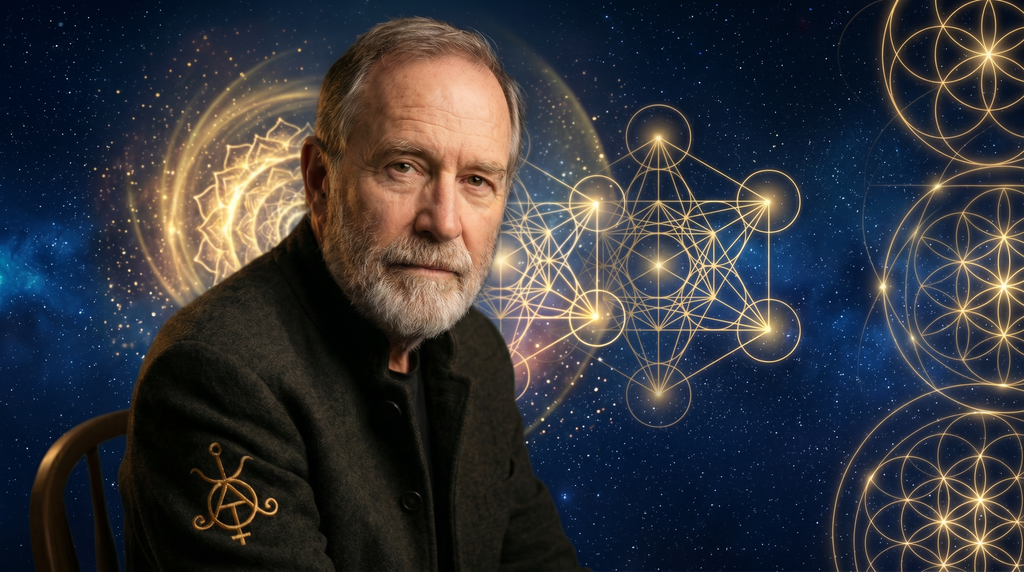
James Sageman is not a theorist who arrived at these questions through books. He is a practitioner who arrived at them through decades of lived experience and then went back and did the reading.
He grew up in rural Vermont, served six years in the U.S. Navy aboard the USS Kitty Hawk, and spent over four decades working in engineering and technical roles in and around Colorado Springs. He is, at his core, a person trained to follow evidence rather than assumption, to test systems rather than accept them on faith, and to maintain a healthy skepticism even, especially, about his own conclusions.
That background makes him an unusual guide for this territory. The spiritual and contemplative content here isn’t window dressing around an essentially emotional sales pitch. It is the serious, disciplined engagement of a person who has spent decades in practice, in meditation, in shadow work, in the study of alchemy as a living transformational system, and who has also spent decades learning to think clearly about evidence and mechanism.
James is also the author of The Great Work: A Guide to Personal and Collective Awakening and the creator of The Great Work Platform, where this course lives alongside his work on Hermetic philosophy, quantum metaphysics, and the relationship between inner transformation and collective change.
“You don’t have to believe in any of this to investigate it honestly. You just have to be willing to follow the evidence wherever it goes.”
- James Sageman
Fifteen weeks. Thirteen modules. One complete map.
The course is designed as a progressive expedition. Each module builds on the previous one, sharpening the instruments before deploying them, establishing the maps before venturing into the territory.
MODULE WEEK TITLE AND FOCUS
Mod 0 Week 1 Orientation: The Consciousness Question
What is consciousness? Does the brain produce it, or filter it? We take the materialist view seriously before we challenge it.
Mod 1 Week 2 Cartographic Systems
Ancient and modern maps of consciousness. From Buddhist jhāna maps to Monroe’s Focus levels. Where do the maps converge?
Mod 2 Weeks 3–4 The Instruments of Perception
The quality of your attention determines everything. Building concentration, sensory clarity, and equanimity through Shinzen Young’s framework and Culadasa’s ten-stage model.
Mod 3 Week 5 The Subtle Body and Energetic Perception
Chakras, prāna, qi, biofields. What do the traditions agree on? What does modern biofield science say? How do you practice honestly, without metaphysical commitment?
Mod 4 Weeks 6–7 Telepathy and Empathic Resonance
A century of serious laboratory research. What the evidence actually shows. How to develop natural empathic perception through structured discernment practice.
Mod 5 Weeks 7–8 Remote Viewing
The CIA’s Stargate program. The complete six-stage Coordinate Remote Viewing protocol. What it feels like from the inside, and how to learn it.
Mod 6 Week 9 Precognition and the Nature of Time
Can consciousness reach forward in time? The empirical evidence, the physics of retrocausality, and the practical training for distinguishing genuine precognitive impression from wishful fantasy.
Mod 7 Weeks 10–11 Out-of-Body Experience and Astral Cartography
The veridical evidence for OBE. Mapping the non-physical territories across traditions. What are we actually exploring?
Mod 8 Week 11 Psychedelics, Entheogens and Consciousness Expansion
The psychedelic renaissance. Three thousand years of entheogenic tradition. Cartographic analysis. Integration as the critical variable. (Educational only.)
Mod 9 Week 12 Mediumship, After-Death Communication and the Survival Hypothesis
Does awareness survive bodily death? NDE research, mediumship studies, reincarnation research. Examined rigorously, without predetermined conclusions.
Mod 10 Week 13 Collective Consciousness, Field Effects and Planetary Awakening
Can group intention alter physical reality? Morphic resonance, the Global Consciousness Project, Jung’s collective unconscious, and practical collective coherence.
Mod 11 Week 14 Discernment, Shadow and the Dangers of the Path
The module most courses skip. Spiritual inflation, cognitive bias, and the psychological shadow of the seeker. The further you venture, the more essential discernment becomes.
Mod 12 Week 15 Living Cartography: Integration and Capstone
Synthesis. Your Personal Consciousness Cartography as a completed document. How do you live as someone who knows?
Good questions deserve honest answers.
Do I need prior experience with meditation or consciousness work?
Basic meditation experience in any tradition is helpful. Complete beginners can participate, but you may want to spend a few weeks establishing a simple sitting practice first. Psychological stability is the more important prerequisite.
I’m a skeptic. Is this course going to ask me to believe things I can’t evaluate?
No. Your skepticism is considered an asset here, not an obstacle. The course is designed precisely for people who want to engage this territory rigorously. Who want to look at the actual laboratory evidence, evaluate the methodology, understand the debates, and draw their own conclusions. The honest answer is that the evidence is stronger than the standard dismissal suggests, and weaker than the enthusiastic believers claim. This course helps you find where it actually sits.
Is there a particular worldview I need to hold going in?
None whatsoever. The one requirement is a genuine willingness to have your existing framework challenged, because it will be, regardless of your starting position.
What does the psychedelics module involve?
Module 8 is entirely educational. It covers the history of entheogenic traditions, the modern psychedelic renaissance in clinical research, and a cartographic analysis of the states these substances can produce. No substance use is recommended, facilitated, or required.
How much time does this course require each week?
Most students find that four to six hours per week covers the module reading, video content, and practices comfortably. The practices work best when distributed across the week rather than compressed into a single session.
What if I have unusual or difficult experiences during the practices?
Module 11 addresses this directly. The course includes grounding practices and discernment frameworks for navigating challenging states. Anyone with a history of psychosis, severe trauma, or significant mental health challenges should consult with a qualified professional before beginning intensive consciousness exploration of any kind.
You’re here because something in you knows there’s more.
That knowing is the qualification. The course provides the instruments, the maps, and the company of others doing the same honest work. The rest is up to you.
Consciousness Cartography: Mapping Non-Local States of Awareness
Fifteen weeks · Thirteen modules · Lifetime access
❖ Thirteen expanded module guides with full research citations
❖ Video content and recommended media for each module
❖ Structured practices and assessment for each week
❖ Consciousness Cartography Journal framework
❖ Community forum access through The Great Work Platform
“The Great Work is here. The Great Work is now. And the Great Work is you.”
James Sageman
$297